The Life and Suffering of Prince Jerian returns to the universe of Sir Brante but shifts the viewpoint from a subject of the order to its future sovereign. The official game and press-kit materials establish a state defined by divine law, inherited social position, several peoples, and a ruling family whose spiritual office is inseparable from political power.
On this page
The Great Arknian EmpireThe Twins and the LotsHouse Tempest, the Primate, and the PactArknians, humans, and competing estatesPlaces visible on the official mapThe Great Arknian Empire
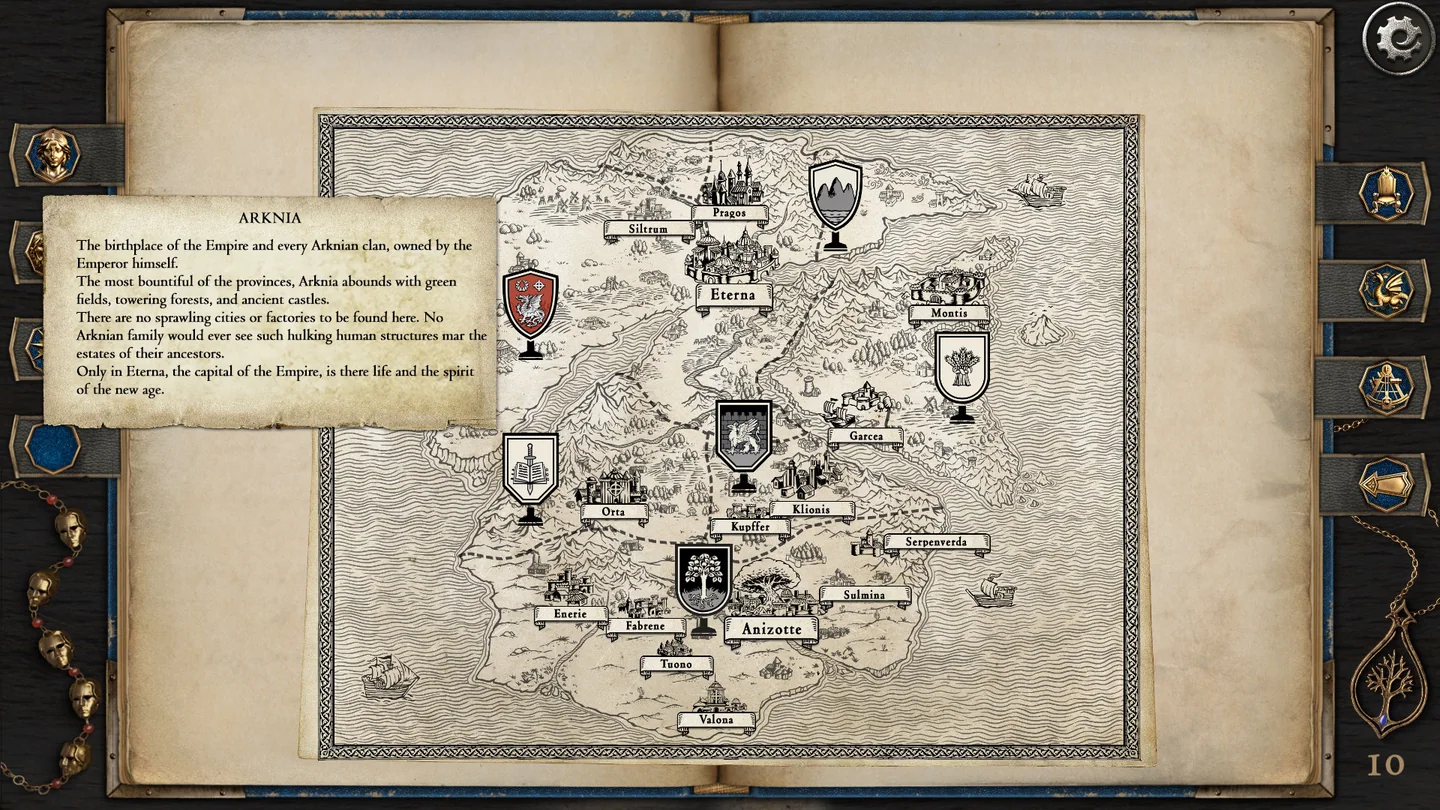
The Empire is a collection of estates and provinces held together by divine legitimacy, noble power, the imperial family, and an increasingly fragile political balance. Arknia is described in an official screenshot as the birthplace of the Empire and every Arknian clan. It is owned by the Emperor, rich in fields, forests, and ancient castles, and centered on Eterna, the imperial capital and a center of the new age.
The official premise presents that inherited order at a moment of exhaustion. The treasury is failing, noble houses defend established rights, commoners demand equality, and the church is divided. Steam outcomes confirm that this strain can widen into civil conflict or the Great War, with results ranging from triumph to national destruction. The Millennial Senate can become an arena for Jerian's Will, a recipient of ceded power, or the institution that defeats him. Prince Jerian lore is therefore political geography as much as a list of places: every province belongs to a state whose legitimacy is being tested.
The Twins and the Lots
The stern gods called the Twins established the ultimate law that divides society into Lots. The sacred order assigns the clergy to guide, the nobles to rule, and commoners to labor in obedience. An official screenshot titled Justice and Compassion describes the Scripture as restricted knowledge ordinarily read by priests, reinforcing how religious interpretation and social control support one another.
The achievements distinguish the Twins rather than treating them as an interchangeable pair. Jerian can preserve the Elder's Love, strengthen his connection to the Younger's Law, challenge the Younger, or find salvation at the Peak by the Elder's will. The Primate achievement describes withstanding the Will of the Gods. These phrases establish affection, law, judgment, and resistance as separate parts of divine experience. They do not explain the complete theology, but they show why Prince Jerian lore cannot separate sacred belief from action: a relationship with either Twin can shape both Jerian's soul and the public order he governs.
House Tempest, the Primate, and the Pact
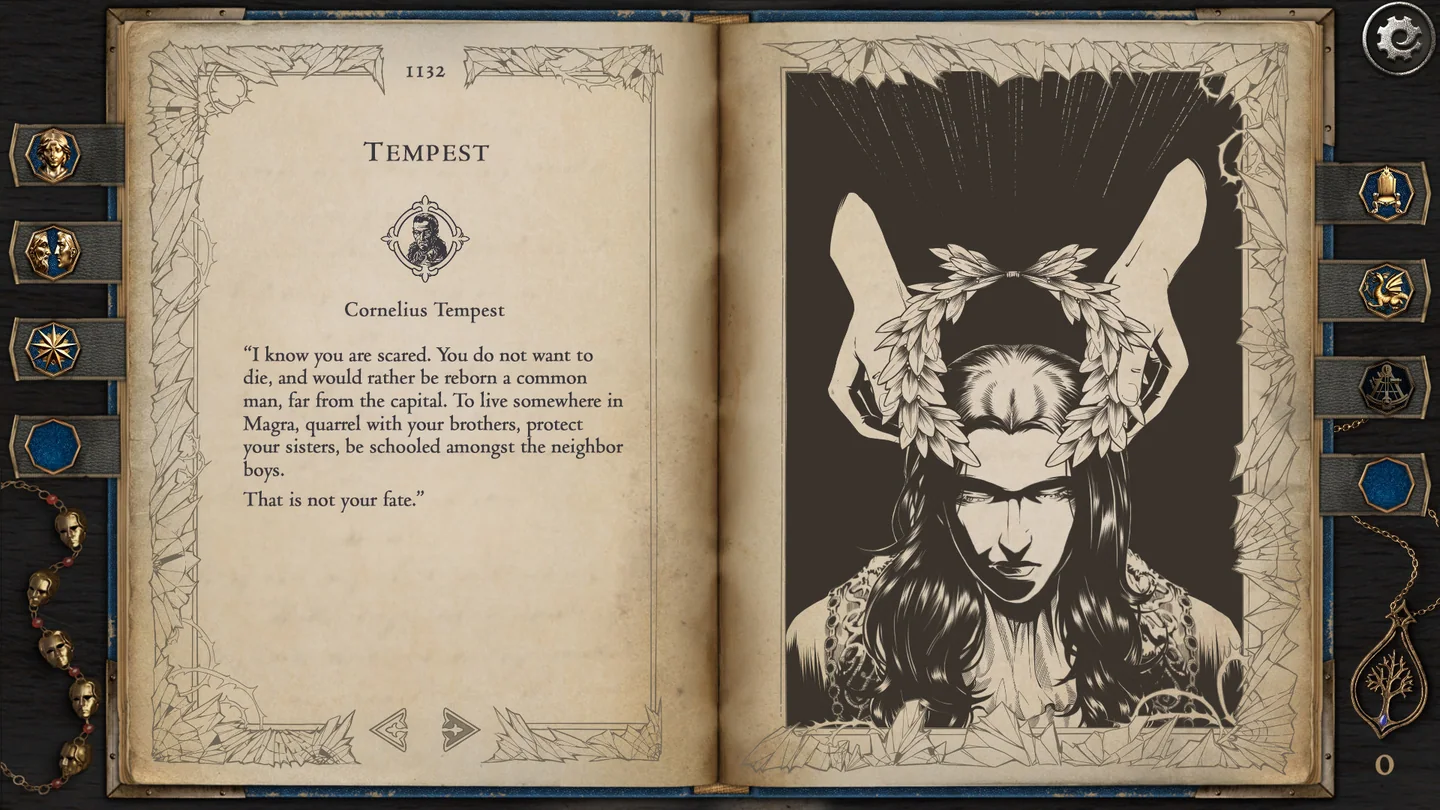
Jerian belongs to the Tempest family and inherits more than a throne. As Primate, he connects mortal and divine worlds. The Tempests keep the Pact, a testament between the Twins and those living by divine will. The story asks whether that agreement can be altered without destroying the world it orders. Steam achievements also confirm family debt, the possibility of preserving House Tempest's unity, and several fates for Jerian's mentor Cornelius.
The public record names Jerian as the Tempest Heir and allows him to become head of the household. It also describes power moving through the family in sharply different ways: Jerian may fill himself or his father with the power of the Tempests, become the family's servant, preserve unity, break his brother's will, or kill his father to seize the throne. Cornelius can return as an ally before the Senate, oversee Constanta, retire, be imprisoned, or face Jerian in a duel. Those outcomes make House Tempest a governing institution, spiritual lineage, and network of personal obligations at once.
Arknians, humans, and competing estates
The achievement Love of the People explicitly distinguishes humans and Arknians, while other entries refer to Arknian privilege, respectable nobles, outcasts, and the Blood Tide. These confirmed terms show a society with divisions beyond the familiar clergy-nobility-commoner hierarchy. Their exact histories belong to the game's unfolding narrative, so this archive keeps the distinction without inventing an encyclopedic account the official sources do not provide.
The political language nevertheless establishes several relationships. Reform is linked to human support, while a traditional course reinforces Arknian privilege. Outcasts can carry a legacy associated with the first Blood Tide outcast, and Jerian can either learn from that legacy or cut ties with it. Friends may become respectable nobles or overindulged vassals, which shows that personal patronage can change formal status. Prince Jerian lore thus contains overlapping divisions of people, Lot, estate, blood, and proximity to the ruler; the official sources confirm the categories without supplying a complete census or social history.
Places visible on the official map
The English press-kit map labels Eterna, Siltrum, Pragos, Montis, Garcea, Kloinis, Kupffer, Orta, Serpenverda, Anizotte, Sulmina, Enerie, Fabrene, Tuono, and Valona. The map also shows provincial crests, ports, mountain chains, rivers, roads, and heraldic seats. These spellings come directly from the 1920×1080 official screenshot and are preserved here as the safest public location list.
Two additional place names appear in official Steam achievement descriptions: Constanta, where Cornelius may be appointed overseer, and Credonville, where Jerian may prevent bloodshed or kill every rebel. They are confirmed story locations even though they are not included in the map-label list above. That distinction is deliberate. Map labels, descriptive geography, and achievement locations come from different first-party artifacts, so the archive records what each source actually establishes instead of guessing borders, distances, provincial ownership, travel times, regional allegiance, later campaign routes, political consequences over time, or alternate spellings that the published material does not state.